Generations: Opeoluwa Odutayo meets Adejoké Bakare
Published 27 November 2025
By Hilary Armstrong
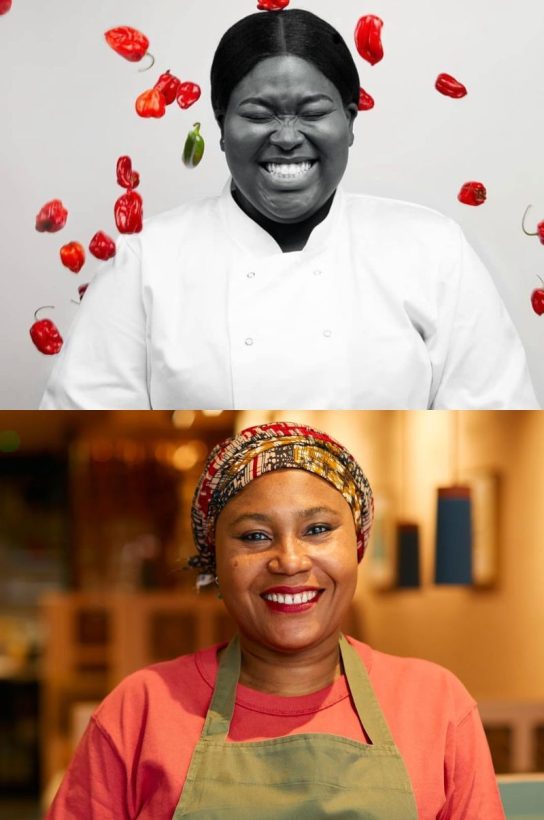
In the first instalment of CODE’s new series, Generations, rising star Opeoluwa Odutayo, a private chef, recipe developer and one of CODE’s 30 Under 30 class of 2024/2025, meets her friend and role model Adejoké Bakare, the chef-owner of Chishuru in London and the first Black female chef in the UK to win a Michelin star. We sat down with them at Chishuru to hear how their contrasting routes they have taken – and the work ethic and passion they share – have shaped their careers so far.
How do you two know each other?
Joké: “Gosh, it’s been three, four years now. Ope came to the restaurant in Brixton and we just got talking. We had people in common and we just hit it off immediately.”
Ope: “Any time I was around the area, I would just pop in and say hello. She’d always give me something to eat.”
Joké: “I was the eternal auntie! That’s how we met”.
You both entered the industry via different routes. Joké, you started with a food van, then a supper club, and a pop-up restaurant. Ope, you learned your trade at culinary college then moved into restaurant kitchens. What do you think are the advantages and disadvantages of the routes you took?
Joké: “There’s always a huge advantage to learning everything on the job but I think it’s a huge plus, if you’re young, to going the classical route and learning the classical method. I kind of envy that because you know how to do it classically. I taught myself mostly. The advantage of that is I’ve not been taught things that I cannot unlearn. I’ll find a way to do something that will be very different from the classical way of doing it and it kind of works for me with what I am doing, the kind of food that I am cooking, but yes, both of them have advantages.”
Ope: “Going to college was very important to me. I went to Westminster Kingsway College. I was six when I watched Food Network and I saw the fire and the flames and the knives and I said, ‘that’s what I want to do’. I didn’t know how to get there but I started researching. My mum would book me into summer school, learning how to bake and to cook; my auntie had a bakery, after school I would do a couple of shifts with her. I had to go to uni – as per an African mother – but after my uni education, I looked at my mum and said I want to be the most educated chef. I want to learn the foundations. Can I go? She said, yes, go. Since then, everything that has happened, I’m thankful for it. Even my education – business and economics – I apply it every single day with everything I do.”
“What I admire in Joké is her audacity. She loves what she does. She didn’t change the taste of palm oil in her food; she didn’t change the taste of African cooking to suit a box. She just cooked from what she knew, what she loved, and what she wanted people to see. And that’s what’s got her to where she is and that’s one thing I definitely admire. She didn’t have to change herself to fit a box; she created a space for herself.”
Joké, what advice would you have for Ope as she establishes her career further? What would you encourage her to go off and do?
Joké: “Just be more audacious. Make mistakes. Fall. We both come from similar backgrounds in that if you come from a certain household, you’re expected to have your first degree and all of that. Also, as a girl, you’re expected to be a helper. You’re not expected to shine too brightly. You’re there to help people and that I feel can hold us back. We feel if you try and push yourself a bit forward you are being prideful. I say to you every time: I love what you are doing. There are people who have half your talent, half your knowledge, who have just been confident enough, audacious enough, [to be out there]. You can be on the stage as well. We have this imposter syndrome. I feel a lot of it doing what I’m doing. Be a Chad! A Chad that feels ‘hey I can do this!’ Don’t be scared to fail.”
Ope, when you look at Joké and her achievements, how much does it inspire you? What do you hope to achieve in your own career?
Ope: “I like that she has a dream and she goes for it and she looks beyond that dream, and someone will see where she’s at now and think [that’s enough] but she’s already thinking three steps ahead, looking at empires! I see that in her. I want to be able to do that. I want to be able to dream and put actions to my dream as well. I have so many ideas in my head and I’ll just hide it and be like ‘it’s not good enough’. I’m really cautious, even about the things that I post on my socials.”
Joké: “It doesn’t have to be perfect. You’ve got amazing talent. Let people see it.”
Do you feel you have a supportive network around you?
Joké: “I’ve been very very blessed. I’ve met amazing people. Loads of female chefs reaching out just to help, ask if I need anything, if I need advice. With recipes, if I’m thinking of something, I can ask have you tried it? What did you do? Loads of people are wonderful and willing to help. That’s the wonderful thing about hospo. For us, a lot of the Black chefs, the Black female chefs, we are now just reaching out and trying to form a network ourselves because there is so much that we know that we face. We’ve walked in those shoes and [can share] how we were able to overcome things. There are loads of female African chefs out there that are doing amazing things.”
Ope: “You have to be willing to reach out to people. Half of the time chefs’ heads are so busy, they’re thinking of so many things, they’ll never know you’ve messaged. If you have a question, you just have to reach out and try once, try twice, keep trying until you get across.”
Joké, how optimistic do you feel about the future for chefs Ope’s generation?
“It’s really hard as an independent in London with rents and business rates. I think it stifles talent sometimes. It’s not good for restaurant-goers because people have a formula that works and everybody uses that same formula. They don’t want to break out of it because the costs are so much. If the landlords are brave enough, if they’ve got the foresight to give one or two people a chance, the London scene will be much more vibrant than it is. It is vibrant; we’ve got one of the best restaurant scenes in the world, but there’s still that thing of people being stifled because of rents and all that.”
Ope, do you see yourself opening a restaurant?
“I feel encouraged to think about it. Before my mindset was ‘no restaurants’ but I wouldn’t mind a test kitchen, a space that was like my studio where people can just come in and try my food. It’s when you talk about rent, my head starts going ‘that’s money!’”