Good, Better, Best – How Victor Lugger turned the QR code into a tool for world-class hospitality
Published 19 May 2026
In partnership with sunday
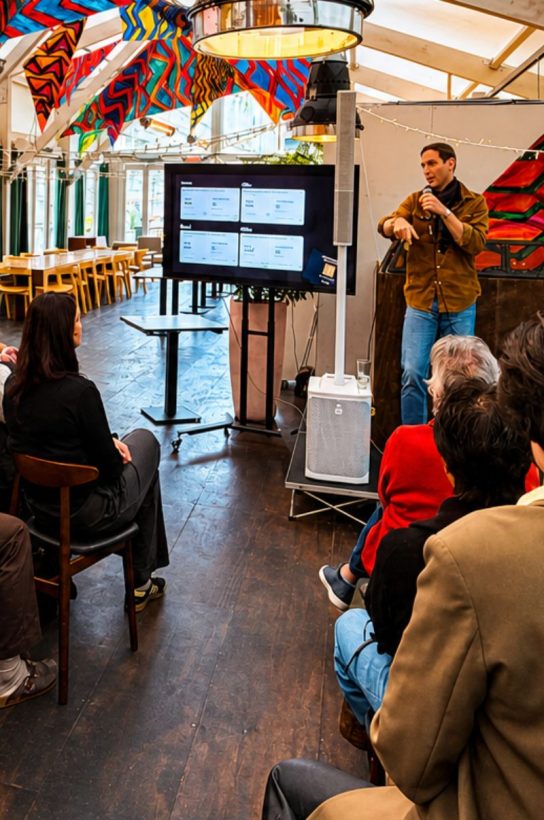
Victor Lugger founded the Big Mamma Group in Paris with Tigrane Seydoux in 2013. The group now operates 36 restaurants across seven countries, with eight more venues opening this year. Lugger represents the new generation of restaurateur-founder operators seeking to reconcile high-touch hospitality with mobile-first consumer behaviour. As CEO of sunday, he argues that mobile payment and hybrid ordering can enhance rather than replace world-class hospitality.
sunday was born of operational reality, not tech ideology
Victor Lugger built sunday during Covid, almost by accident. He had seen QR code ordering emerging elsewhere but initially rejected it because, like many operators, he believed hospitality depended on human interaction.
“I remember seeing images of QR codes for menus in China and the US where restaurants were reopening and thinking “F*** me, they’re ghastly”. Big Mamma’s playful menus were a big part of its brand identity; the last thing he wanted was a QR code instead of a menu. He did however introduce QR codes for payment when his restaurants reopened.
Big Mamma’s guests liked paying with a QR code payment
“In November 2021, I got a report from our CFO saying 71% of our, at the time, 10,000 guests a day, in four countries, were paying with a QR code. That’s nuts to me”. He couldn’t believe the numbers but the data forced a shift in thinking. QR codes were not a downgrade in hospitality, but a preference from guests.
Mobile payment will become the industry standard
Lugger compares sunday to the early days of online restaurant reservations. Just as platforms like OpenTable, Resy, and SevenRooms normalised digital booking, he believes mobile payment will do the same for transactions.
“Twenty years ago, online reservations didn’t really exist at all. And when it started, every chef and good restaurateur under the sun said “Oh, I’m never going to do that. We’re about hospitality. They need a human voice over the phone.”
He is willing to bet that within seven years, “most people, in most restaurants, in most cities in the Western world” will pay on their phone, most likely via a QR code.
According to sunday’s research, 93% of guests in London, if given the opportunity to pay with their phone, will do so. That compares with around 82% who make reservations online.
More striking still, Lugger cites internal usage data. In its fifth year, sunday processed payments for 82 million people using QR codes, three times the volume of Uber in its equivalent early growth stage.
Hybrid ordering changed Lugger’s view of digital hospitality
Hybrid ordering is a flexible service model allowing diners to choose between traditional table service and QR-based ordering and payment.
Lugger admits his team will say he resisted it for years, believing guests were not ready. The turning point came with Arcade, where adoption two and a half years ago quickly exceeded expectations. Soon, more than 90% of guests across two £10m venues were using QR-based reordering daily.
Hybrid ordering is designed as an option, not a replacement
Lugger stresses that sunday is not about removing servers or replacing human interactions. It is just one more option. “Giving people a choice is, by far, the best hospitality.”
He believes adoption will accelerate naturally as demographics shift. By 2030, 38–40% of guests will be Gen Z, many of whom are comfortable reordering digitally as default.
How it is used varies by operator. Camino uses it for extra drinks orders during service. Arepa & Co deploys it outside peak hours to reduce staffing pressure while preserving high-touch service where it matters most.
Reordering is a major new opportunity to drive sales
Big Mamma has begun rolling out hybrid ordering selectively. At Pizzeria Popolare in Paris, guests can now reorder coffee, desserts and drinks. The site serves around 450 covers daily at lunch. “We launched last week… 32% of people used it in the first week. Today we have increased average spend by 20% with hybrid ordering. We’ll probably be at 30 or 35% in a year.”
The commercial impact goes beyond faster payments
“The number one reason why I introduced mobile payment at Big Mamma is hospitality. It’s really great that we get more Google reviews, and save money, and turn tables faster and add loyalty – but that’s all business KPIs. The number one reason I do this as a CEO, that I’m growing this product, is because I truly believe that it is the best hospitality.”
Even fine dining operators are seeing results. At Trishna, the Michelin-starred restaurant from JKS Restaurants in Marylebone, 70% of payments now go through sunday, with table turn times improving by 12 minutes.
Wealthier diners, bigger spenders, value convenience most
Lugger argues adoption is strongest among higher-spending guests.
“They’re the ones who get the most crazy about waiting for their check. They are not used to waiting, they are priority at Heathrow, they buy online every day with Shopify. These people love sunday way more than your average British. This is why London, by the way, is the best city for us because there is such a concentration of wealthy people.”
He adds that expectations carry across price points. “I have restaurants with a £75 average spend and a £28 average spend. The reason why I use sunday in my £75 average spend restaurants is because, in these, I am overfocused on the quality of hospitality. It’s being up to standard, keeping up with what modernity has to offer. All these people have paid with sunday already at Big Mamma and at Dishoom, and when they’re spending £300, you’re telling them they have to wait for the check?”
For Lugger, mobile payment is not cost-cutting but experience design. Removing friction at the end of the meal frees staff for higher-value human interaction.
sunday is a full hospitality ecosystem
Lugger no longer sees sunday as simply a QR payment company. It is evolving into a full hospitality ecosystem including hybrid ordering, pay-at-table, order and pay, click and collect, and own-channel delivery. loyalty, white-label apps, delivery ordering and guest retention. He argues restaurants need direct digital relationships with customers instead of relying entirely on platforms like Deliveroo or Uber Eats. sunday integrates deeply with POS, loyalty and reservation systems rather than operating as standalone QR tech.