Notes from a small island
Published 8 January 2026
By Hilary Armstrong
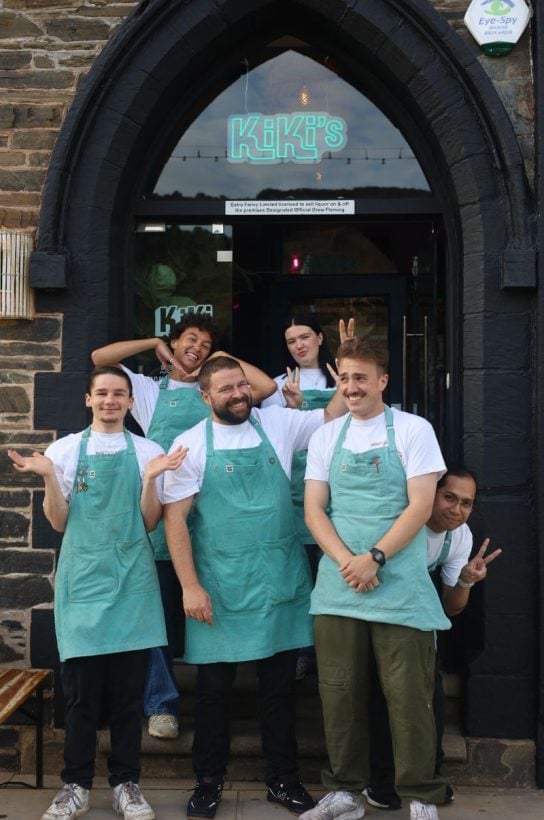
What can big city operations learn from an independent tiki bar on the Isle of Man? Plenty. Kiki’s in Douglas, founded in late 2020 on the Isle of Man (population: 85,000) was named one of CODE Hospitality’s Happiest Places to Work 2025. It was praised by judges for its holistic approach to hospitality that honours the specificity of its location, while being anything but insular. Founders Drew Fleming and Jamie Lewis share their take on island life.
Some challenges you face at Kiki’s are specific to your location on the Isle of Man. How do you find recruitment, for example?
Drew: “Being on an island with a very small population, we’ve had no choice but to train from scratch. I think there’s a lot of operators who perhaps don’t give young people the best introduction to a career in hospitality. We want to be the antithesis of that and do everything we can to legitimise a career in hospitality in a place that isn’t a big city. We have a robust training programme for new hires, training all of our team in all positions; everybody does everything. It’s a hive mind approach.”
We want to be the catalyst of a true cocktail culture here. For us, a measurement of success in ten years would be that someone like Ewan who started with us at 17, washing glasses, has opened their own place. The seeds fall from the tree and you get a whole forest.”
How important is it for you and the team to look beyond the island?
Jamie: “Drew was the recipient of the World’s 50 Best Bar Scholarship back in 2022. It was at that point that we identified that there’s a lot of competitions you can enter but there’s an additional barrier being here. There’s a flight or boat fare – you’re not just going on the train for the day – there’s accommodation for a minimum of two nights. So we introduced a scheme to cover flights, accommodation and expenses [for competitions and trips away]. That’s one of the initiatives that we’re both most proud of. We could be very insular and happy that we’re the best cocktail bar on an island of 85,000 people. But we have a population of young people that leave the island then move back when they’re starting to have families; if we can send them away prepared for a bar job and they’ve got some pedigree, that’s a really nice thing.”
Drew: “Bartending is all about connection. It’s not just connection to the guests but connection to your peers. It’s important for [young bar workers] to feel they are part of something bigger, to feel inspired.”
Jamie: “There is maybe a bit of fatigue around guest shifts and takeovers but the benefits for us are twofold. If we’re bringing someone to the island, we’re giving our guests the opportunity to visit one of the world’s best bars without leaving the Isle of Man, and, in turn, our staff, are getting a real learning opportunity. Being able to send them, even for a night, to London, Manchester, wherever, to do a shift with someone can have a huge impact on them.”
You’re very open about burnout being a risk in hospitality, bars in particular.
Drew: “I think perhaps sometimes in hospitality, people’s thresholds for burnout can be lowered, especially in the bar side of the industry, because of how exposed you are to alcohol both on the days you’re working and on the days you’re not. One of the most basic things we changed was whenever we do socials, they’re not always anchored around alcohol. It’s so easy just to throw a party.”
“It’s almost like a pendulum swinging between working hard and playing hard. We just want to slow the [swing of the pendulum] down. It’s never going to be still – you need that, not the extremities, but you need the hustle – but we can keep it steady. That’s where the Isle of Man perhaps does have a leg up, because it’s a place where work-life balance can be afforded: you’re never more than 12 minutes away from the seaside.”
Jamie: “The longest commute is about 25 minutes. They’re not having to get the tube or a night bus home.”
Drew: The other thing that the guys like is that everybody’s on just four-day weeks. They would rather do four long days, then get three consecutive days off.”
How different are the challenges faced by a bar?
Drew: “In bars, especially our style of bar, it’s always high energy. Every night of the week is somebody’s Saturday night. But you can get to work and be like: ‘I just don’t want to speak to people’. Nobody’s going to be 100% or even 90% every day, we know that, but we are a business and we want guests to feel great and for the team to facilitate that. Because everybody is trained in everything, somebody could be like, ‘you know what, please do me a solid, I just don’t want to speak today’, and they could swap with somebody with a prep shift. We would never question them.”
Did you start with these ideas or did they evolve as you’ve gone along?
Jamie: “One of the original things we did was we’d always order food after the shift. Not necessarily because people were hungry but it was just an opportunity for everyone to sit down, have a bit of a bitch and a moan, and a debrief. The school of thought there was it’s 3am, you’ve been cleaning up vomit, and you’re knackered but you’re just going home, still thinking about the mean customer that said something horrible. You’re getting it out of your system. Things evolved from that.”
Drew: “It depends on the team. The team we have at the moment are the most mature we’ve had and quite holistic, so we respond to that and just try to meet their needs. You can’t go wrong as long as you’re listening to the team.”
Jamie: “Awarding that same level of reactiveness that we give our guests to the team as well.”
Did you pick up your approach from others outside the industry or within?
Jamie: “My first job was with McDonald’s and honestly, it’s the absolute bedrock of everything I’ve done in hospitality. It’s taught me leadership skills, how to be empathetic. The training programs that they give are world class. My first bar job was for Vodka Revolution. Those two things shaped me. You learn from the good leaders that you work for.”
What more do you feel you can do?
Drew: “If we thought we could do more right now, we would probably be doing it. That’s not to say that’s there’s not things that we can improve on. The demands change all the time and problems change all the time. You’ve constantly got to revisit [things] and keep listening. We’re both quite boots on the ground and I think it allows us to really keep close tabs on the pulse of the team.”
Do customers benefit from the good vibes? Why is it good for business?
Drew: “A hundred per cent, a million per cent. Ultimately, everyone wants a low staff turnover, but also, we’re a bar in a small city where we have so many regulars that all the team have great relationships with that surpass the stereotype of bartender and bar guest.”
Jamie: “The thing that I found limiting working for chains is that there’s a set procedure for a birthday, or for things which are intended to have that feel good factor. We’ve obviously got to give our guests continuity but we also have to be different every time. A group of 10 might each come in for their birthday, and we’ve got to try and find a different way of celebrating each time, giving the team the flexibility to achieve that. We’re never going to tell them off if that demands a bottle of fizz, as long as they can justify that.”
Drew: “Because we have great relationships with every person we employ, there’s a level of trust there that’s probably way higher than the average employee-employer relationship. The team know if they spill a glass of red wine over somebody, they can go as above and beyond as they deem necessary, and they’re going to have our full support. We’re under no illusion that while what we sell is drinks, the reason people come back is because they leave ten times happier than when they arrived.”
Kiki’s is a small bar in a small town but you make no apology for being ambitious.
Drew: “It’s driven by wanting to prove people wrong. It really really really grinds my gears when people are like ‘it’s just the Isle of Man’. So many people think there’s a glass ceiling on the Isle of Man, like we can’t have good things or we’ll never have a Michelin star restaurant on the Isle of Man. Why not? Is there a law against it? People think so many facets to the Isle of Man are a weakness when really they’re your greatest strength. We love the island and we work really closely with the tourist board to try and grow the Isle of Man’s food and drink marketing and tourism.”
Besides workplace culture, tell us more about the bar – what makes Kiki’s different?
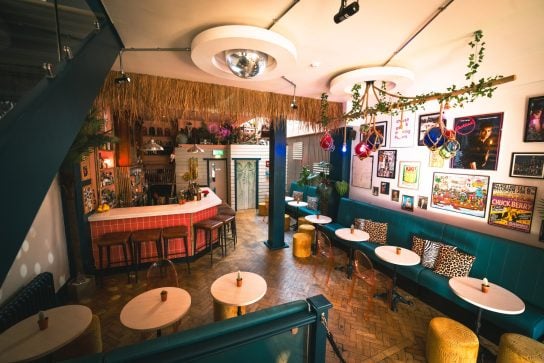
Drew: “The hook for the bar itself is tropical bar, not tropical island, because obviously the Isle of Man, hello? Have you ever been in October? Nowhere near as glam as it is in August.”
Jamie: “There’s sometimes a little catfishing. If people come and do shifts with us or come over during the summer, it’s really tropical and they’re like this could be the Ibiza of the British Isles.”
Drew: “Essentially, we are trying to drag tiki or tropical – because we don’t really like the tiki term – into the 21st Century. Tiki is cribbed bits from Polynesia; it’s cribbed bits from the Caribbean; it’s cribbed bits from Asia; It has kind of dragged that all together into this Frankenstein’s monster. We use the framework of Tiki, but celebrate Isle of Man history. So for instance, when we first opened, in classic Trader Vic’s style, we traded trinkets for bar tabs.
Jamie: “The reason we feel comfortable in selling tropical in the 21st-Century is that our story is rooted in more than just wanting a tropical bar. We opened during the pandemic which was very different on the Isle of Man. They basically closed the borders and there were two years where it was very difficult to leave the island. The idea for a tropical bar and not so proper Island was rooted in that, that we wanted to give people a little holiday.”
Drew: “People responded super well to that and now when we’re bringing bars over, it’s part of that escapism, part of that pillar of Kiki’s identity – providing something completely different to what would normally be expected through island life.”
Jamie: “We’ve actually got the Dead Rabbit coming from New York next year. We’re still pinching ourselves that they said yes.”
ADVERTISEMENT

ADVERTISEMENT