The Golden Rules of Restaurant Design
Published 6 November 2025
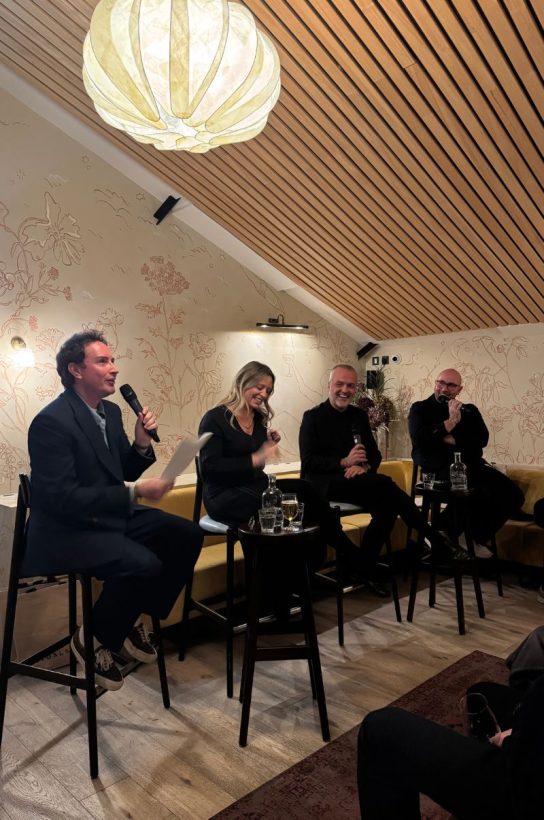
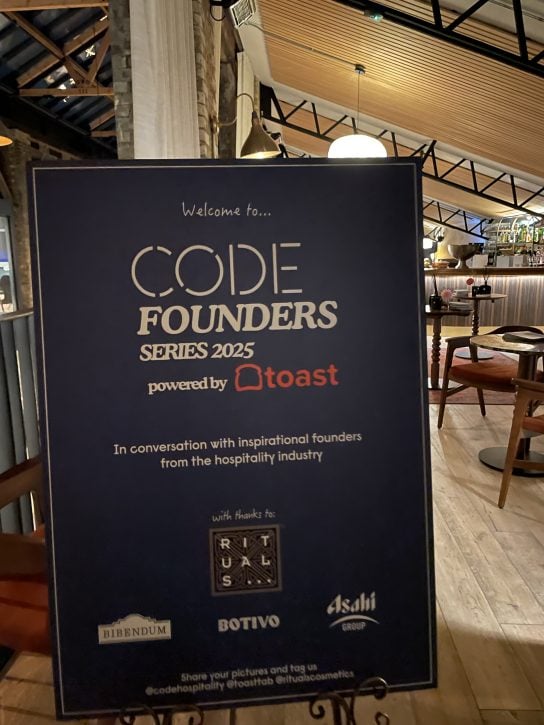
For the third and final of CODE’s Founders Series 2025, powered by Toast, we brought together three leading voices in hospitality design: Martin Kuczmarski, the former COO of Soho House turned founder of The Dover in Mayfair; Shayne Brady, founder of Studio Shayne Brady, known for creating some of the world’s most beautiful dining rooms, from Jeremy King’s The Park to The Aubrey at Mandarin Oriental Hyde Park; and Laura Hart, co-founder of Wildflowers in Belgravia, whose background in interiors and styling informs the restaurant’s elegant but warm and welcoming aesthetic.
The sold-out event took place at Bar Flor, the new bar opened by Laura and her partner, chef Aaron Potter, above Wildflowers. It’s a gorgeous, surprising space; fully open along one side, with chic hand-painted wallpaper along the other. The pintxos came in generous waves – honey-drizzled Manchego, thick-cut chorizo, fuet and giant olives – alongside pours of wines from Bibendum, Botivo spritzes and ice-cold Asahi beer. Gorgeous fragrances by Rituals wafted across the room (and went home with the guests in their goodie bags).
The theme of the evening was design and what makes a restaurant beautiful. Perhaps unsurprisingly, the conversation quickly shifted from how a restaurant looks to how a restaurant feels – the very essence of hospitality. These are the golden rules we learned:
Leave the trends for others to follow
“I was very clear about what I wanted to do,” says Martin Kuczmarski of The Dover’s old school brand of hospitality. “I wanted to go back [in time] a bit. I’d go into a restaurant and the first thing I’d see would be a computer. No “hello, hi, good evening, how are you?” Let others follow the trend; I’ll do what I feel is missing”.
Bring fresh eyes to the project
“The designers I worked with hadn’t done a hospitality project before,” says Kuczmarski. “So they didn’t come with preconceived ideas, saying ‘we’ve used this lamp in Dubai, let’s just change it’ or ‘we used this pattern on the walls, let’s use it here somewhere’. They were open-minded.
Sweat the details
“Good design doesn’t require budget. It requires superb attention to detail,” asserts Kuczmarski. Getting essentials such as chair height right is what matters. Guests might not see it but they will feel it. “When we built The Dover, I sat in one chair 22 times because I was not happy. It was too high, too low, too wide…It had to go back to the factory 22 times.”
Get the layout right
“I mentally sit in every chair on the plan to see what the guest is actually looking at,” says Shayne Brady. “Straight away, you notice that they’re looking at the back of the waiter station or they’re staring at the door to the toilet.”
Rethink the ‘bad table’
“We try to get as many ‘star tables’ in as possible,” says Brady. “They’re corner tables where two people can sit on a diagonal to each other as opposed to opposite. It’s more intimate and romantic. We love a ‘railway carriage’ as well, particularly along a window. If you put a banquette against a window, somebody has to have their back to the window, whereas if you put a railway carriage side by side along the window everyone can look at each other and glance out at what’s happening outside.”
Good acoustics make for a good atmosphere
“At The Dover, we have three tablecloths on the table to absorb the noise,” says Kuczmarski. “As we became more successful and the room became noisier, we thought ‘what shall we do next’? So we put a very thick carpet under the tables so it absorbs the noise even more.” Better acoustics appeal across the generations.
Cross the t’s, dot the i’s.
“It’s really important that the eye can relax,” observes Wildflowers’ Laura Hart. “If you’ve got open shelves, make sure they are filled with beautiful products or dressed nicely. There are so many restaurants that don’t finish off those details. Your eye will fall on them and it will bug you throughout your meal.”
Inspiration can be close to home
“Before we even saw the site we knew what we wanted it to feel like: we wanted it to feel like home, like opening up our house. Somewhere people can feel relaxed and it doesn’t feel pretentious. When we saw the site, it was an empty concrete block; it could easily have felt very new, very shiny. We really lent into warm textures and textiles, layering them to make it look like it had been here for a while.”
Don’t fixate on other restaurants
“We wanted Wildflowers to feel really homely so obviously we looked more at residential interiors than other restaurant interiors,” says Hart. “We looked at big country houses with open kitchens, islands, and all our cookbooks on display. We wanted it to feel like us so that’s a really easy starting point to be honest.”
Natural light isn’t the be all and end all
Natural light sounds good but you can’t control it; sometimes it’s too bright, sometimes it’s too dull. Take control of it. Kuczmarski takes a dim view of complex automated lighting set-ups. His switches can go “one and off, up or down”. At The Dover, he chose not to cover up the existing windows with chic panelling to prevent artificial light from the offices outside affecting the atmosphere inside.
Ditch the cookie cutter
Designs don’t always translate from one building to another, or from one culture to another. “I’m absolutely happy to design sisters or cousins of each other but not twins,” says Brady.
Find inspiration anywhere and everywhere
Inspiration can come from travels, books, magazines, even the pattern on a dress, says Brady. “I’m passionate about history and heritage and that’s really where I start”. At The Gallery at The Savoy, he came up with the idea of painting shadows of dancing figures around the walls, a nod to the dinner dance, which is said to have originated at the hotel in 1912.
Tell a story
“Jeremy [King] will always have a story,” explains Brady of the restaurateur with whom he has been collaborating some 17 years. “Sometimes they’re made up, sometimes they’re not. The story provides a foundation to return to again and again. Ask yourself if any design decision you make relates to that initial story, that person, that character.”
Don’t design by committee
“You can’t have ten people around the room telling you what chairs you want,” says Kuczmarski. “If you feel strongly about a chair, go for it. When you design by committee, you start chipping away at the initial inspiration, then you end up with something that is not yours, something that is mediocre. If you have an idea and you strongly believe it is the right one, stick to it.”
Design for longevity
“Nothing saddens me more than seeing one of our designs ripped out,” says Brady. “It doesn’t happen often but it does happen. We try to design with an integrity of materiality choices that hopefully makes it hard for the next restaurateur to rip it out. I don’t believe in putting in things that feel whimsical or on trend that can easily be ripped out. When it comes to value engineering, notoriously the first thing we discuss is the leather on the banquettes. We can value-engineer the leather but the client will be replacing it in two years. Great leather will last ten to 15 years. When we take over a restaurant, I don’t believe in ripping out everything that’s there. I’ll see if there are things we can salvage and use as part of the new design.”
Keep it simple
“If you want the design to last, don’t overdesign it, keep it simple,” says Kuczmarski. “I always say that simplicity is the maximum expression of elegance. If you keep it simple the design will last. Otherwise, in two years time, the new lamp will come out, the new colour will come out, and the restaurant will feel old.”
What’s a red flag to one designer will be a green flag to another
Low ceilings, for example, needn’t be a problem At the Audley at Mandarin Oriental Hyde Park, Studio Shayne Brady embraced the “exceptionally low” ceilings for the former Bar Boulud, and made them darker, timbercladding to create a “cocooning, intimate space”. “When you look at a site,” says Brady, “It’s really about what feel you want to get. Can it be the space you want it to be?”
Start with a budget and stick to it
“From the beginning you have to say I’m going to spend ‘x’ amount of money and you have to stick to it. Any designer, any kitchen specialist, any light specialist, they’re going to try to sell you the biggest, the newest, the most expensive. With landlords, you can say can you contribute? [At Soho House] we had a lot of joint ventures with local partners at the beginning. You ask ‘Can you pay for the extraction? Can you pay for the kitchen?’ If you imagine taking the building, turning it upside down and shaking it, if it falls, I pay for it; if it is still attached, you pay.”
Consider who’s using the space
“It’s very much drawing on the history of the building and the location you’re in and who’s using the space,” says Laura Hart. “That’s what I keep coming back to. Whether you’re designing for a client or for yourself, the person using the space at the end of the day is our guest coming in and people coming back. How they feel and how they use the space is really important.”
ADVERTISEMENT

ADVERTISEMENT