What Makes a Happy Team?
Published 24 September 2025
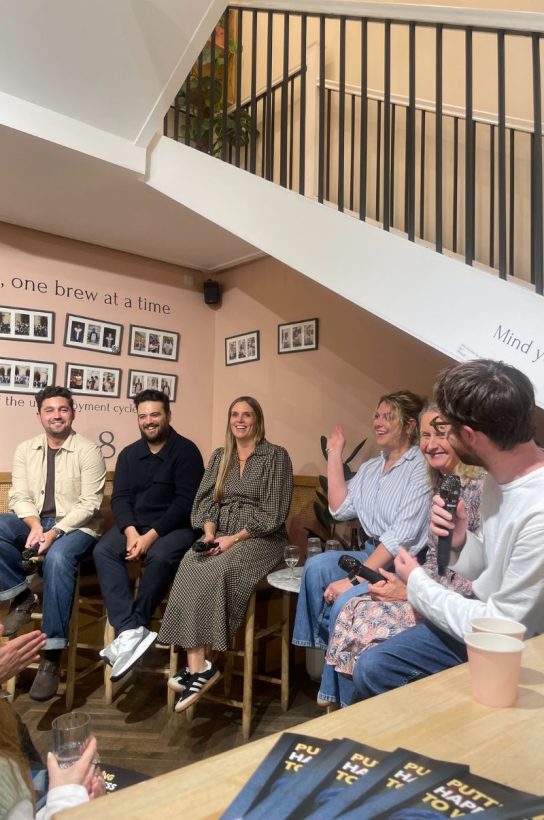
This week, CODE brought together some of the winners of CODE Hospitality’s Happiest Places to Work, in partnership with Planday, for an uplifting panel talk at Fair Shot café, a social enterprise supporting young adults with learning disabilities, in Covent Garden. Over cocktails and canapés, our panel of industry leaders – Dan O’Regan, founder of Bank and Lapin in Bristol; Marc Summers, founder of Bubala; Rose Ashby, director of development and projects at Spring, and Serena von der Heyde, founder of Georgian House Hotel, along with Planday’s VP of Growth, Sarah Haddon – generously shared their wisdom in a free-wheeling discussion about workplace happiness that covered everything from neurodiversity to menopause to training and equity.
If you weren’t able to make the event, here are some edited highlights.
A happy team doesn’t just ‘turn it on during service’.
Because that isn’t, ultimately, the be all and end all. It’s the entire ecosystem making sure that everyone’s happy.
Marc, Bubala.
When an employee doesn’t share our values, it’s really, really clear to see.
We run quarterly ‘ERIC’ sessions where we discuss how we use our values [expression, resilience, integrity, compassion] in our day to day. It’s really amazing how strong it is. And actually, when people don’t show those values, it’s really, really clear to see now, and often it highlights that maybe that person isn’t quite right for our business.
Marc, Bubala
From day dot, I said I’m going to earmark 20% of the business for the management team.
I hired Jack who was my head chef from day one at Bank, and now he is an equity partner with me at Bank. The deal was that when we opened future restaurants, he had the opportunity to put some of his own money in and have a bigger chunk. So now we’re fully fledged business partners; we’re co-owners of Bank and Lapin. What’s really massively rewarding is – and he wouldn’t mind me saying this – there was no clear path for him to ever own a restaurant. Having been a chef for 16, 17 years; he was likely to just be a chef for a very long time and probably never be an owner. He now co-owns two restaurants. It’s quite rewarding to see people get an opportunity to step up. It’s not generosity. He earns it.
Dan, Bank & Lapin.
You can’t just give promotions because there’s a ceiling to how many jobs are available when you’re growing on a small scale.
But you can give people a sense of autonomy. If you can dissect your business down into miniature businesses, you can put people in charge of one thing. So, if someone has a keen interest in wine, they can look after the wine list. They can build the list, cost it, manage all the supplier relationships, and really put their stamp on the business. If someone says ‘great wine list’, I always make a point to say, Carol, our restaurant manager, was entirely responsible for it. Nothing to do with me.
Dan, Bank & Lapin
We try to make people feel they are constantly learning and growing, so there’s no need to leave.
A lot of people who leave want to come back. I think it’s a combination of [a couple of things]. We have two biodynamic farms that we get two deliveries a week from and they grow only for us, so they love the produce. The quality is really beautiful, and people love it – that’s part of the reason I’ve been there for 11 years. Also, we have really good education initiatives. We have a masterclass program which runs twice a month and we do monthly supplier trips. There are lots of things that make people feel like they are constantly learning so there is progression. As soon as that stops, you want to find something new.
Rose, Spring
Our masterclasses are fully booked every single month.
We’re in our second year of running our masterclass series. We have all sorts of classes. Some might seem quite random like calligraphy and colour matching but others are very food-centric like cake decoration, butchery, knife sharpening, lacto-fermentation, how to make miso, koji, yoghurts – skills, in the day to day running of Spring, we wouldn’t necessarily teach you. You’re paid to come for two hours; we put everything on for you; we give you the supplies you need. It’s fully booked every single month.
Rose, Spring
Some people are just looking for a nice place to work.
A lot of our team are older. We’ve got somebody who is 70. Definitely, younger people are looking for learning, for progression, and so on, but actually some of our older team members – we’ve got somebody who is 70 – aren’t looking for that. Actually what they’re looking for is a nice place to work, where they’re valued, where there is stability. They want a regular shift pattern so they can plan their lives better or work around their kids or whatever else. So we have to be looking for opportunities for young people to make sure they’re being stretched but at the same time understand that that’s not for everybody.”
Serena, Georgian House Hotel
There have to be open channels of communication so there’s no mystery around anything.
The main focus when I was head chef of Spring for eight years was improved communication. We do appraisals twice a year, so every single person sits down with their line manager for half an hour and talks about their progress and what they want and how they can be promoted. One of the main things they asked for was transparency on all pay structures and job descriptions for every level. There’s a clear guide: this is exactly what you need to do to be promoted; these are very specific bespoke points just for you, so you can get to the next step.
Rose, Spring
The more diversity you have in your business, the better it is.
We started off [addressing] gender but then, quite quickly, broadened it out to cover all the different protected areas. We have four people with a disability working in Georgian House, and that’s changed quite a lot how we had to work. We had some training across the business by Mencap to make sure that we were supporting our colleagues as well as possible. It’s been probably the best thing we’ve ever done in the business. For instance, we’ve got three people with autism [at Georgian House]; sarcasm really just does not work for those team members, and so we just avoid it. And if you speak English as a second language that’s also really helpful.
Serena, Georgian House Hotel
I felt so vulnerable when I started talking about my menopause symptoms.
Starting to talk about things that were challenging led us on to be more considerate about all the different things that people might be facing. I started talking about the fact that I had menopause symptoms; you know, half the people in my business, more or less, are likely to go through it. I felt so uncomfortable talking about it and felt so vulnerable, I found it really challenging, but the upshot was that people started to talk about domestic abuse, depression, the challenges that autistic team members faced. There were so many things that came out of that. Starting to be more considerate and more understanding within your business actually supports an awful lot of people.
Serena, Georgian House
Diversity breeds innovation and creativity.
I truly believe in creating inclusive spaces and inclusive teams. Not everyone thinks the same. In terms of how you communicate with your team, how you approach scheduling, work with them on their preferred method of communication. Some people want things written down so they can absorb them and reflect on them in their own time. Think about what working patterns work for these individuals; neurodivergent people tend to prefer late shifts because it’s how their body clock works. These things can be incredible super powers if you get under the hood of them. Then you can create really happy teams.
Sarah, Planday
ADVERTISEMENT