The CODE Lunch: Romano’s at Simpson’s in the Strand
Published 18 June 2026
by Hilary Armstrong
Introducing the CODE Lunch, a new series which sees CODE sit down to lunch at a major new restaurant opening in the company of a restaurateur. This is not a review – we’ll leave the barbs and the broadsides to our colleagues in the press – we’re more interested in talking shop, sharing insights, and looking at a new opening through a restaurateur’s eyes. What do they see that a normal guest might not? What do they admire? What do they envy?
First up, we head to Romano’s, the first floor restaurant at Jeremy King’s Simpson’s in the Strand, that opened at the end of March, four weeks after The Grand Divan, the street-level restaurant, opened its doors. The critics were straight into The Grand Divan but Romano’s, as the later arrival – second children will sympathise – has not had the same attention.
Ross Shonhan, the Australian founder of Lilibet’s, the grand and glamorous new seafood restaurant which opened its doors in Mayfair last year, is our first guest. Shonhan, the former Nobu executive chef and founder of Bone Daddies, is good company, who knows a thing or two about the ups and downs of opening expensive, ambitious and long delayed projects in the heart of the capital. We join Shonhan at Romano’s for lunch and conversation covering ambitious openings, starting from scratch, and what might just be the most polarising dish in London.
CODE Members can find Lilibet’s, now live on the CODE app, with 30% off food.
Ross Shonhan arrives for lunch at Romano’s wearing a sharply cut black jacket with a brooch pinned on the lapel: a nod, not to contemporary red carpet fashion, but to the waiters’ uniforms at Lilibet’s, his Mayfair restaurant. As menswear style statements go, it couldn’t be further from the bespoke three piece suits by Timothy Everest favoured by Jeremy King, in whose new restaurant Romano’s we are having lunch today. However, the two restaureurs have things in common, “common pain points” as Shonhan delicately puts it (read: years of delay, contractors in liquidation).
Certainly, it’s a challenging time to be opening big new restaurants and both Shonhan and King have done it in the last year; the former with 160-cover Lilibet’s opened last September – “the same day as Carbone”; the latter with Simpson’s in the Strand (comprising 135-cover Romano’s, The Grand Divan, Nellie’s and Simpson’s Bar) in March 2026. So they’re in the same school year, as it were. Both Lilibet’s and Romano’s are new but founded on historical back stories, fictionalised to a greater or lesser degree. Lilibet’s reimagines the life of the young Princess Elizabeth who was born at 17 Bruton Street, where Lilibet’s is now, had she not become queen. Romano’s meanwhile looks back at a restaurant of the same name on The Strand, which was bombed in 1941.
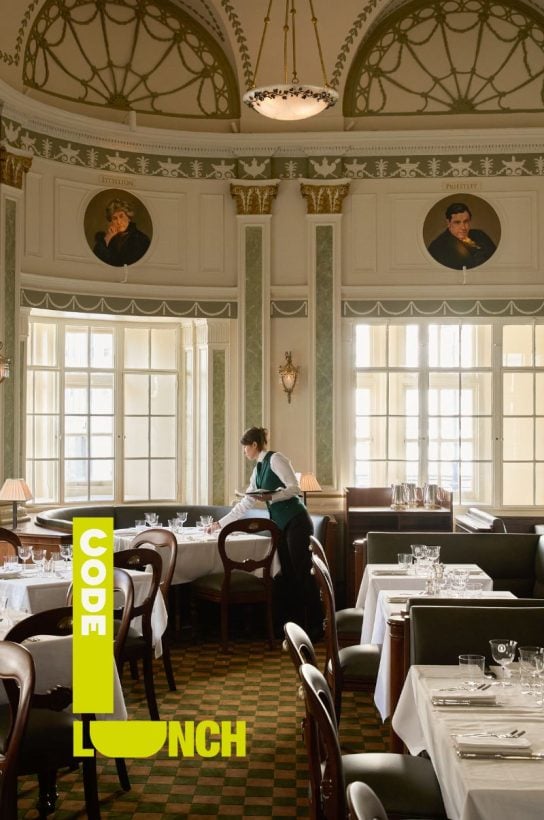
It’s Shonhan’s first time at the revived Simpson’s in the Strand. Surveying the room, and admiring the Wedgwood-like plasterwork on the high ceilings, the mirrored columns, and the portraits of playwrights gazing down at diners from the frieze (we’re directly under JB Priestley), Shonhan says: “Neither of our restaurants were small financial undertakings. I can’t imagine what this cost to bring to life”. The key difference between the two men’s new restaurants is that Shonhan started with an empty box, whereas King’s space had all the bones “albeit needing a good X-ray, let’s say, and a bit of surgery”. “We’re both doing a classic restaurant experience, let’s say,” says Shonhan. “But we [Lilibet’s] are the new kids on the block, right? I don’t have anywhere near, not even comparable to, the reputation of Mr. King. We’ve [started] from a standing start. This has got 200 years of history which in itself is a story you don’t need to write.” These stories, these histories come into their own, says Shonhan, with big undertakings. “I think more and more if a restaurant’s got scale it needs to have more than just great food and drink and service. There’s got to be more to it. There’s got to be a reason why.’
This has got 200 years of history which in itself is a story you don’t need to write
Simpson’s is such an ambitious project, says Shonhan, there were only a few people he could imagine taking it on: King himself, Richard Caring, Soho House Group, possibly Gordon Ramsay. “With the exception of them, I’m not sure who else could have brought a beast like this back to life.”
The menu at Romano’s is an intriguing mix of British dishes with a French accent, some retro dishes, but also some contemporary touches like savoury crumpets. So you’ll find pork pie and piccalilli next to salade à la Russe, steak and kidney pudding next to steak frites, and Bakewell tart alongside crème caramel. There are some real throwbacks too like veal and crayfish marengo, about which Shonhan declares himself “officially stumped”: “People would rather look something up on Google on their phone than actually ask a team member.” As for “Crème Pink ‘Un”, Romano’s signature crayfish bisque: “Well they clearly want it to be ordered because that’s the only thing on the menu that’s pink.” (The dish is apparently named after The Sporting Times, known as the Pink ‘Un, whose staff had a weekly dinner at Romano’s).
Shonhan sees a clear throughline from Romano’s to Zédel, King’s homage to Paris’ democratic brasseries and bouillons, which apparently did as many as 1000 covers a day. There’s a prix-fixe at £24.75 for three courses and a formule at £29.75 for three courses with a glass of wine which has since been replaced by a £19.75 post-theatre menu. Side orders – which were all in on our visit last month – are now ordered separately which feels more modern.
At Lilibet’s, Shonhan reckons he has redesigned the menu “probably four or five times since we opened. Sometimes when you’re doing something new; sometimes, you’re just trying to make it make sense to a guest.” The three-course lunch at Lilibet’s has been £29/£34 from day one – not so much more expensive than Romano’s, although the Mayfair high-roller could quadruple that spend and then some with the addition of luxuries such as wild red prawns, oysters, sea urchin etc. “We’ve always done set lunch; we’ve always done £5 negronis; we’ve always done £7 pints of Guinness. We just want people to come in and use the place.” He balks at Lilibet’s being seen as a flashy Mayfair restaurant. “I always say I have priced it more with an eye on, let’s say, premium Soho [and Shoreditch] restaurants, like the Mountains or the Brats.”
“It will be interesting to see how long it stays like this,” observes Shonhan. “Whether this is an opening menu, because you can always go up; you can never go down. You can add a couple of pounds once people are comfortable with you. You can add a few pounds to each dish and people may or may not notice.”
No wine today: Shonhan’s got meetings after lunch and will be in the kitchen in the evening, as he often is. “Not through any flaw in my team,” he adds. “I’m less comfortable out here than, say, a Mr King, so I retreat back to the kitchen, then pop my head out and chat to the guests then retreat back again.” The kitchen is where he does his thinking, a hands-on process, in collaboration with head chef Alex Harper, formerly of the Harwood Arms.
I would be curious to see if it’s here in six months.
The first courses arrive, with a scotch egg for Shonhan – “I’m a sucker for a scotch egg” – and braised celery hearts with bone marrow crumb for me, an unusual dish of two inexpensive ingredients. “Both tough sells”, as Shonhan notes. He had told me he eats everything but not, it transpires, celery: “I hate celery! I cook with it. I put it in dishes, but I’m not a fan. I would be curious to see if it’s here in six months. I hope I’m wrong! If I’m wrong, it means broadly London has a more exciting palate than I would expect.” It’s a clever, delicious dish that Romano’s has since highlighted in its newsletter: “We have not exactly been surprised by your enthusiasm for celery, but it has given us no shortage of delight”. (This celery enthusiast hates to say I told you so…)
My main course is the mysterious veal marengo, a tomato-based stew packed with crayfish and served with white rice. Shonhan, who comes from Queensland, Australia, and jokes he misses the pies at home more than he does his family, has the “pie of the day” – an ox cheek and mushroom suet pudding with a super rich sauce – and reckons it is as good a pie as he’s ever had. Shonhan grew up on an isolated cattle property in Queensland, hadn’t really been to a restaurant until his late teens and he started working in them. His mission for 2026 is to get out more. “I’m a little embarrassed to say I don’t [eat out a lot], but you have to as an operator. It helps you see your own operation in a different light. If you can take away an ego, and just look really intelligently at what other people are doing, there’s a lot to learn.”
“It’s never as good as you intend it to be in those first few months, you know? The first few months, you’re taking an entire group of strangers and pulling them together and asking them to push in a common direction. It takes time and you have to listen.”
You can see him crunching the numbers, eyeing up the fine details, seeing how the business model works. At one, while we wait for dessert – a sticky toffee pudding, on the dainty side, to share – Shonhan lifts up the tablecloth, a real restaurateur move, and admires the curved timber tabletops beneath. “It’s a lovely table. It costs money to do that curved timber detail. Generally, you don’t spend money on tabletops, if you’re going to cover them with table cloths so I wonder if the intention was to have no table cloths and perhaps acoustically, it became too much.”
Looking around the room, still taking stock of the operation, he wonders aloud about the scale of the undertaking. “I wonder if he’s having sleepless nights,” he says of King. “I have sleepless nights.”
When the bill arrives, I gasp audibly to see that at £99.76 it hasn’t even hit three digits. It’s on us but I insist Shonhan takes a look: it’s been a while since I’ve paid under £100 for a three-course lunch in such a smart room in Zone 1. It’s a nice feeling.
Does seeing Romano’s tempt Shonhan to dream up another concept? “Nah! One and done,” he says. “I think we’re often get caught up in this idea of growth and more doesn’t even mean more. I think just having one great restaurant that people like and makes people happy and is busy is enough. That’s my learning after Bone Daddies.”
We say our goodbyes, but Shonhan isn’t quite ready to leave. He’s off to have a nosy around the rest of the building. A restaurateur doing what restaurateurs do.
Lunch Bill
Scotch Egg, £6.75
Celery Hearts, £9.75
Ox Cheek Pudding, £21.75
Veal Marengo, £26.50
Sticky Toffee Pudding, £9.25
Still Water x 2, £7.00
Macchiato, £5.75
15% Service Charge, £13.01
TOTAL: £99.76
Romano’s, 100 Strand, London, WC2 0EW, simpsonsinthestrand.co.uk