Victor Lugger’s Postcard from America
Published 3 July 2025
Victor Lugger is back from America. The Big Mamma co-founder and entrepreneur behind checkout platform sunday, is not the first European restaurateur to return from the United States fizzing with energy, passion, and renewed vigour, and he most certainly won’t be the last, but what makes Lugger’s recent sojourn in the US so unusual is that he spent an entire year there, not in New York or Chicago or LA, but in Atlanta in the Deep South, immersed in the hospitality scene as both a tech founder (sunday launched in the US four years ago) and restaurateur (spoiler: Big Mamma USA incoming).
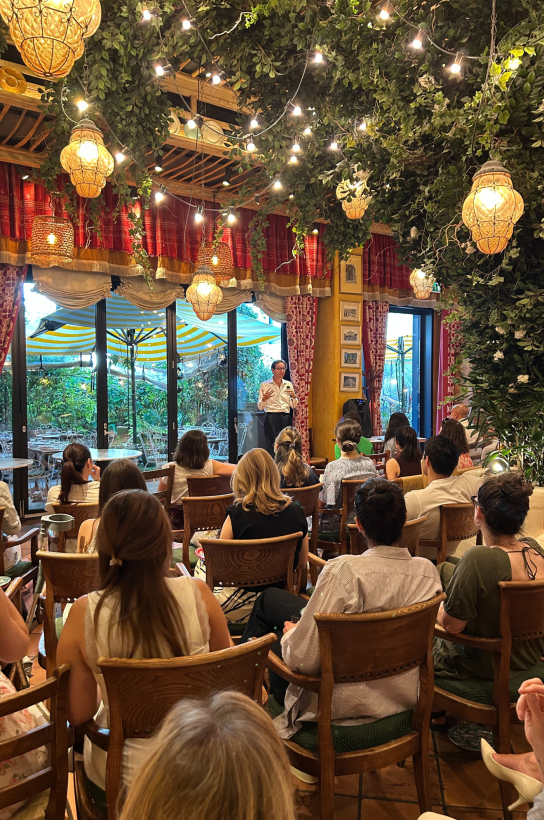
In characteristically open fashion, Lugger wants to share his learnings with his colleagues here in the UK. At two sold-out CODE Hospitality events at Circolo Popolare in Fitzrovia, in front of an audience of his fellow hospitality professionals, Lugger spoke at length about his year in America and the powerful insights he gathered there about service, innovation, data, customer loyalty and, above all, hospitality. Here are seven of his takeaways.
In the US, they don’t do restaurants. They do hospitality.
The number one difference I noticed is the culture of hospitality. To compare it with France—my personal take is that the UK stands in the middle between France and the US—in France, the restaurant is the chef’s show. It’s all about the food. It’s a chef-driven culture. It’s evolving, of course, but it’s where we come from. In the US, they’re influenced by Danny Meyer and his book Setting The Table, by Will Guidara and Unreasonable Hospitality. These two guys, I think, capture what hospitality should be and what American hospitality is about. It’s all about the guest. We French people may say the food is not as good because we want to reassure ourselves but is the food less good? No. The food can be very good.
Restaurant design is better on this side of the Atlantic
While the design of the average American restaurant may not yet match the level we see in London, one thing they absolutely do better in the States is lighting. One restaurant I would invite everyone to check out in the US is Hillstone. It’s the brand every restaurateur would have loved to build in America, from the trendy people in New York to the big chain restaurants. Hillstone is the reference steakhouse, impeccable service, impeccable process, impeccable culture. The lighting at Hillstone is the best thing I’ve seen in America.
Outside New York, LA, Miami and Chicago, you get a very different view of food trends
We all know that the United States is polarised. We have LA, New York, Chicago and Miami Beach on the one side, and then you have 230m people on the other side. It’s extremely polarised and it is not changing. I’ve been the CEO of a US Company for four years. I was always travelling to New York, Chicago, Miami and LA and I thought that was America. Well, spend a year in Atlanta in Georgia, which is almost as big as France, and you get a very different view on food trends. You have a lot of people who have a lot of money but they don’t travel a lot. When you travel in America you understand why half of them don’t have a passport. America is so beautiful, some don’t see the need to travel, so they have no clue about what’s in Italian restaurants in Italy. Of 20 or 30 restaurants in Atlanta that are $15m top-line, 90 percent of them are steakhouses. Some of the best restaurants in New York have failed in Vegas because the guest is 95% American middle class and they want something very different from your Manhattan clientele. Saying you want to go to America is like saying you want to go to Europe. It’s a sum of countries and you have to decide where you’re going to start. You can have a $200m restaurant business just in Florida. You can have a $400m restaurant business just in California. We looked at Texas, Florida and New York and eventually chose Florida because it’s more business friendly, the people are well travelled. Tigrane, my co-founder, is moving next week to Miami with his family. We’re now actively working on doing something in America.
Americans are so data-driven
That’s something I’ve observed, typically talking about sunday with C-level teams or founders. People are generally just more data-driven, that’s a fact. In America, 60% of restaurants are chains, another 20% are groups. In the UK, you have 10% chains, and 90% independents. By definition, you have more single owners—one person who is managing everything in that restaurant. In the US, most restaurants are led by the C-level team, people who are specialised in data, in marketing, in finance. These people have a deep understanding of their data. That is just something I noticed. It’s made us reflect a lot about our mentality and how we drive things. I’m not saying we’re any better.
Online reputation is a very big deal.
I had not grasped that 99.9% of restaurants in America are destination restaurants. You drive everywhere. You go to a nice restaurant and it’s in a parking lot in the middle of nowhere. And so, because every restaurant is a destination restaurant, people are way more geared towards their online reputation. That has been one of the reasons why sunday exploded there because we give everyone a very simple opportunity to rate the restaurant. When you have everyone rating your restaurant on Google and not just the haters, you get thousands and thousands of good reviews. This is transformational for an American restaurant where 100% of their traffic is destination.
Loyalty schemes work
I have yet to see loyalty work in one full-service restaurant group in Europe. I have seen loyalty that works in America. How do they do that? First, they pay a lot of money for it, between five and ten percent discount. Another reason is you have groups that are way bigger. One group that does incredibly well is Lettuce Entertain You which has 60 restaurants in Chicago. If you’re in Chicago, you might go to the restaurants 10, 12 times a year and you will spend $300 every time. So, if you save 5-10% that’s a result. The second thing they understand is that loyalty is a sub part of payment—like with British Airways loyalty. You don’t think about it, you just buy your plane ticket and know that every year or every other year, you will get £150, £200 off your flight. You just click a button and it’s deducted from what you pay then you start again. The hard part is not how you build the loyalty program, but how do you integrate it when people pay by credit card? Because people pay more digitally in the US, it works. Loyalty is creating brand preference. I’ve seen a lot of brands that are way more advanced in the US.
People are drinking less alcohol in the US
It’s a small detail, but the first thing I did two months ago was say: let’s get non-alcoholic beer in every one of our restaurants. In the UK, we had them already; in the rest of Europe, where we operate, no one was really asking for them. My guess is that this is about to change. It’s a growing trend, and it’s not just 22-year-olds – it’s everyone. People are drinking less, eating differently, and that shift in lifestyle is going to impact London too.
To read more interviews with leading industry figures, click here

A message from sunday
Sunday is the ultimate all-in-one checkout, revolutionising hospitality. From QSR to Michelin-starred dining, it’s making payments effortless for thousands of restaurants worldwide. To learn more about sunday, click here.
ADVERTISEMENT

ADVERTISEMENT